B.E. Electronics & Computer

B.E.

Electronics & Computer


Offered at: Goa Campus

Building Innovators in Electronics and Computing


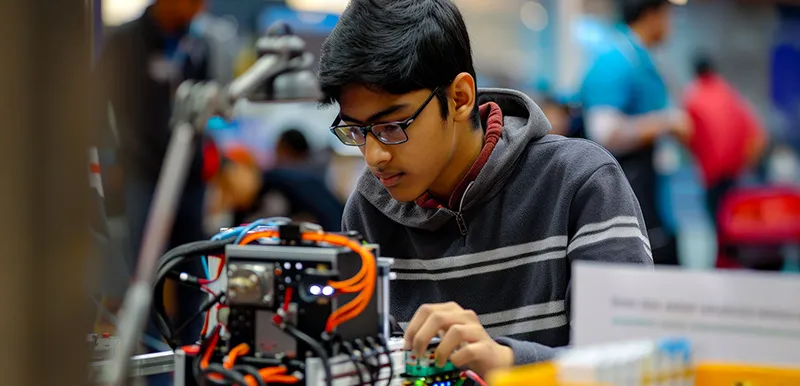
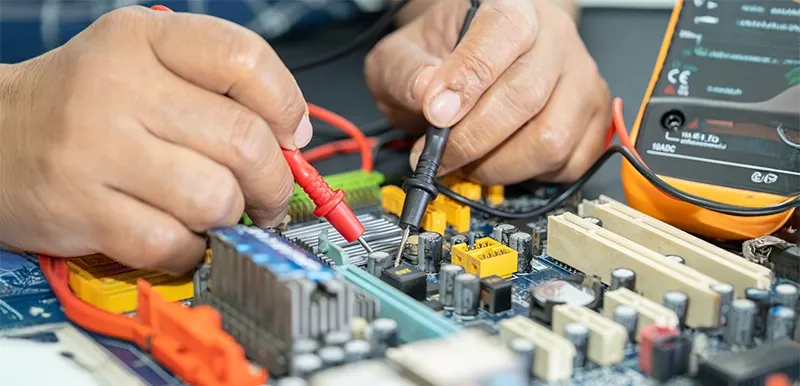
The B.E. in Electronics & Computer Engineering at BITS Pilani, Goa, is a rigorous and interdisciplinary programme blending key principles of electronics, computer science, and emerging technologies. Students will sharpen their skills in digital systems, microprocessors, software development, and embedded systems, while also developing critical problem-solving and analytical skills, which are important for the current evolving times. The curriculum amalgamates experiential learning in state-of-the-art infrastructure labs, preparing students for industry trends and the future world of work.



Design a Degree That Works for You


At BITS Pilani, your academic path is not Linear. It allow you to customise your learning path
according to your aspirations, goals and interest.
The structure of degree programmes and academic regulations also provides certain other flexibilities like choice of electives, number of electives, repetition of courses, departure from normal pace, withdrawal from or substitution of course(s), etc.
Students interested in exploring courses beyond the scope of their curriculum can opt to audit them. This option is for casual learners who are not enrolled in a degree programme.Courses such as Foreign Languages and Music are offered in addition to the core degree programmes. Students may take these courses on an audit basis, subject to the payment of additional fees.
High-performing students may transfer to:


Higher Degree or Ph.D. programmes


Between Ph.D. and Higher Degree levels (based on academic standing). This flexibility supports seamless progression for research-driven students.

One of the most popular flexibilities offered by our educational structure is the dual degree scheme, under which students concurrently work towards completing two integrated first degrees within a reasonable timeframe. All students admitted to Group B programmes are also eligible to work under this scheme for one of the Group A programmes. Assignments to programmes are made based on individual performance during the first year.


In the assignment of dual degrees, first priority is given to students in Group B seeking a second degree under this scheme from among the programmes in Group A. After fully satisfying the known needs of the first priority, a second operation is done to consider the other priority, namely, students in any group seeking a second degree from amongst the programmes in another group. While it would be academically and procedurally acceptable for a student admitted to Group A or B programmes to seek a second degree in Group C in the dual degree scheme, the reverse process is not normally possible. However, a student admitted to Group C will be eligible to compete for a dual degree in any degree in Group C, or any degree in Group B or MMS, but only in Group A.

Practice School
The Original Experiential Learning Model


The Practice School Programme is a hallmark of BITS Pilani’s experiential learning approach. It provides students with an opportunity to practice what they have learnt in global organisations under the supervision of a mentor. Students work on cutting-edge technologies and have the option to practice in their discipline of study or cross-disciplinary areas. In addition to providing students with an opportunity to play roles that require multifunctional skills, this flagship programme also offers many students the chance to secure a PPO.

Click the edit button to change this HTML

Practice School-I

Practice School I is an eight-week course conducted during the summer term after the second year of study. Students are stationed in an organisation during this programme, and after a comprehensive orientation, students largely learn through observation and work on group projects, under the guidance and mentorship of industry experts and a faculty member from BITS. This not only serves as a first exposure for students to the corporate world but also helps nurture their personality traits, communication, and presentation skills.
Practice School-II

Practice School-II offered in the final year of study is a TWENTY-TWO-week full-time program. First-degree students in their final year of study can register for this program either during the first semester or the second semester, and Dual-Degree students can register for a double-semester PS-II program. For higher degree students, the course is titled Practice School, and such students can register for it in their final semester of study.
Practice School Process

Practice School I is an eight-week course conducted during the summer term after the second year of study. Students are stationed in an organisation during this programme, and after a comprehensive orientation, students largely learn through observation and work on group projects, under the guidance and mentorship of industry experts and a faculty member from BITS. This not only serves as a first exposure for students to the corporate world but also helps nurture their personality traits, communication, and presentation skills.

Programme Structure

Focus: Building strong basics in science, mathematics, and engineering principles

  • BIO F110 - Biology Laboratory
  • BIO F111 - General Biology
  • CHEM F110 - Chemistry Laboratory
  • CHEM F111 - General Chemistry
  • MATH F111 - Mathematics I
  •  
  • PHY F110 - Physics Laboratory
  • PHY F111 - Mechanics, Oscillations & Waves
  • BITS F110 - Engineering Graphics

Focus: Expanding core engineering knowledge and computational skills

  • MATH F211 - Mathematics III
  • Humanities Electives
  • ECOM F213 – Object-Oriented Programming
  • ECOM F214 – Electronic Devices
  • ECOM F215 – Digital Design
  •  
  • ECOM F222 – Discrete Structures for Computer Science
Focus: Advanced topics, electives, and specialisation courses

  • Open/Humanities Electives
  • Discipline Electives
  • ECOM F313 – Analog & Digital VLSI Design
  • ECOM F342 – Computer Architecture
  • ECOM F343 – Communication Networks

Focus: Research, electives, and practice school

  • Open Electives
  • Discipline Electives
  • BITS F221 – Practice School I (Summer term after Year 2, for PS option only)

Master Electronics & Computing with Industry Leaders
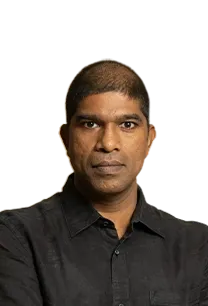
A Amalin Prince


Professor,
Department of EEE
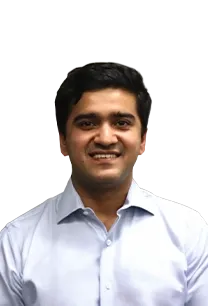
Akshay Madan


Assistant Professor

Anita Bhagirathji Agrawal


Associate Professor

Admissions: Everything You Need to Know


Students work hand-on in specialised, fully equipped facilities.

Admission Process

Eligibility Criteria

Fees & Refund Policy

Scholarship

Education Loan

Important Dates

You Asked.
We Answered.

At BITS Pilani, it is an integrated first degree that amalgamates core electronics with computer science foundations, delivered under the EEE department and structured for 8 semesters (4 years).

Yes. This course combines electronics with computer science. You will learn both hardware design and software development, making it broader than just CSE or EEE.

The curriculum at BITS Pilani begins with a strong foundation in Mathematics, Physics, Programming, Analog & Digital VLSI Design and Digital Design.

Yes. Admission to this programme at BITS Pilani is done via the BITSAT entrance exam conducted by the university.

Yes, you can- BITS Pilani follows a flexible credit-based system, allowing students to accelerate or extend their degree timeline.

You must have completed Class 12 with Physics, Chemistry and Mathematics with a minimum of 75% in three subjects and 60% in each subject.

Yes, BITS Pilani offers a variety of electives in AI/ML, IoT, Robotics, Communication Networks and VLSI in later semesters, depending on your interest.

At BITS Pilani, the course is designed to be completed in four years, which comprises 8 semesters.

At BITS Pilani, students secure average salary packages between ₹12–18 LPA, with top offers going to ₹30+ LPA across global tech and consulting firms.

Graduates are recruited by Google, Microsoft, Intel, Qualcomm, Amazon, Deloitte, Infosys, and Accenture, along with core electronics and semiconductor leaders. BITS Pilani’s 90%+ placement rate and global alumni network further strengthen career prospects.

Program Type
Content Type
Degree

B.E. Biotechnology in Applied Molecular Biology

B.E. Biotechnology

Applied Molecular Biology


Offered at: Dubai

Shaping the Future of Life Sciences Through Molecular Insight


The B.E. Biotechnology with specialisation in Applied Molecular Biology at BITS Pilani is a four year undergraduate level course designed for students to gain a deep understanding of biotechnology as well as its molecular foundations. By integrating biotechnology fundamentals with applied molecular biology, students gain practical exposure relevant to life science, healthcare and research environments. The course emphasises practical learning via lab work, modern molecular techniques as well as project-based experiences. Students are well prepared to pursue roles in biotech industries, research institutions as well as advanced studies to contribute to innovation in life sciences and biotechnology fields.


Design a Degree That Works for You


At BITS Pilani, your academic path is not Linear. It allow you to customise your learning path
according to your aspirations, goals and interest.

The structure of degree programmes and academic regulations also provides certain other flexibilities like choice of electives, number of electives, repetition of courses, departure from normal pace, withdrawal from or substitution of course(s), etc.

Students interested in exploring courses beyond the scope of their curriculum can opt to audit them. This option is for casual learners who are not enrolled in a degree programme.Courses such as Foreign Languages and Music are offered in addition to the core degree programmes. Students may take these courses on an audit basis, subject to the payment of additional fees.

High-performing students may transfer to:


Higher Degree or Ph.D. programmes


Between Ph.D. and Higher Degree levels (based on academic standing). This flexibility supports seamless progression for research-driven students.

One of the most popular flexibilities offered by our educational structure is the dual degree scheme, under which students concurrently work towards completing two integrated first degrees within a reasonable timeframe. All students admitted to Group B programmes are also eligible to work under this scheme for one of the Group A programmes. Assignments to programmes are made based on individual performance during the first year.


In the assignment of dual degrees, first priority is given to students in Group B seeking a second degree under this scheme from among the programmes in Group A. After fully satisfying the known needs of the first priority, a second operation is done to consider the other priority, namely, students in any group seeking a second degree from amongst the programmes in another group. While it would be academically and procedurally acceptable for a student admitted to Group A or B programmes to seek a second degree in Group C in the dual degree scheme, the reverse process is not normally possible. However, a student admitted to Group C will be eligible to compete for a dual degree in any degree in Group C, or any degree in Group B or MMS, but only in Group A.

Practice School
The Original Experiential Learning Model


The Practice School Programme is a hallmark of BITS Pilani’s experiential learning approach. It provides students with an opportunity to practice what they have learnt in global organisations under the supervision of a mentor. Students work on cutting-edge technologies and have the option to practice in their discipline of study or cross-disciplinary areas. In addition to providing students with an opportunity to play roles that require multifunctional skills, this flagship programme also offers many students the chance to secure a PPO.

Click the edit button to change this HTML

Practice School-I

Practice School I is an eight-week course conducted during the summer term after the second year of study. Students are stationed in an organisation during this programme, and after a comprehensive orientation, students largely learn through observation and work on group projects, under the guidance and mentorship of industry experts and a faculty member from BITS. This not only serves as a first exposure for students to the corporate world but also helps nurture their personality traits, communication, and presentation skills.

Practice School-II

Practice School-II offered in the final year of study is a TWENTY-TWO-week full-time program. First-degree students in their final year of study can register for this program either during the first semester or the second semester, and Dual-Degree students can register for a double-semester PS-II program. For higher degree students, the course is titled Practice School, and such students can register for it in their final semester of study.

Practice School Process

Practice School I is an eight-week course conducted during the summer term after the second year of study. Students are stationed in an organisation during this programme, and after a comprehensive orientation, students largely learn through observation and work on group projects, under the guidance and mentorship of industry experts and a faculty member from BITS. This not only serves as a first exposure for students to the corporate world but also helps nurture their personality traits, communication, and presentation skills.

Programme Structure

Focus: Strong fundamentals in mathematics, basic sciences, and core engineering skills.

Courses :

  • Biology Laboratory
  • General Biology
  • Chemistry Laboratory
  • General Chemistry
  • Mathematics I
  • Engineering Graphics
  • Computer Programming
  • Mathematics II
  • Workshop Practice
  • Electrical Sciences
  • Technical Report Writing
  • Probability and Statistics
  • Thermodynamics
  • Physics Laboratory
  • Mechanics, Oscillations and Waves

Focus:Building strong foundations in biological sciences and biotechnology, integrating genetics, microbiology, chemistry and analytical techniques.

Courses :

  • Mathematics III
  • Open / Humanities Electives
  • Biological Chemistry
  • Microbiology
  • Biophysics
  • Cell Biology
  • Environmental Studies
  • Principles of Economics or Principles of Management
  • Open / Humanities Electives
  • Genetic Engineering Techniques
  • Genetics
  • Introduction to Environmental Biotechnology
  • Instrumental Methods of Analysis

Focus:Advancing expertise in molecular biotechnology, bioprocess engineering, immunology, and experimental techniques, with flexibility through electives.

Courses :

  • Open / Humanities Electives
  • Recombinant DNA Technology
  • Industrial Microbiology & Bioprocess Engineering
  • Discipline Electives
  • Immunology
  • Experiments in Biotechnology
  • Downstream Processing

Focus:Advanced specialisation through electives, industry immersion, or research-driven projects.

Courses :

  • Open Electives
  • Discipline Electives
  • Practice School II or Thesis

Faculty Driving Excellence in Biotechnology Education

Dr. Arunkumar Palaniappan


Associate Professor,


Department of Biotechnology

Dr. Debostuti Ghoshdastidar


Assistant Professor,


Department of Biotechnology

Dr. Shrikant Charde


Professor of Practice,


Department of Biotechnology

Admissions: Everything You Need to Know


Students work hand-on in specialised, fully equipped facilities.

Admission Process

Eligibility Criteria

Fees & Refund Policy

Scholarship

Education Loan

Important Dates

FAQs

The programme focuses on molecular biology, genetic engineering, biochemistry, bioinformatics and applied biotechnology, preparing students for research, healthcare, pharmaceutical and industrial biotechnology applications.

This specialization blends biology with engineering, emphasizing molecular-level processes and living systems, unlike traditional engineering disciplines that primarily focus on mechanical, electrical or physical systems.

B.E. Biotechnology with Applied Molecular Biology is a four-year Integrated First Degree programme combining foundational sciences, core biotechnology courses, laboratories and research-based learning.

Students study genetics, molecular biology, microbiology, biochemistry, bioinformatics, cell biology, analytical techniques, data interpretation and laboratory skills essential for applied biosciences.

Applicants must complete Class 12 with Physics, Chemistry and Biology or Mathematics, meeting minimum academic requirements as prescribed by BITS Pilani’s admission guidelines.

The B.E. Biotechnology with Specialisation in Applied Molecular Biology is offered at the BITS Pilani Dubai Campus.

Graduates pursue roles as biotechnologists, molecular biologists, research associates, clinical research coordinators, quality analysts and bioinformatics professionals across biotechnology-driven industries.

Graduates can pursue MS, M.Tech, MBA, MEM or PhD programmes in biotechnology, molecular biology, bioinformatics, biomedical sciences and related interdisciplinary domains.

Students gain hands-on experience through laboratory internships, research projects, industrial training and summer programs, building practical skills and professional exposure.

Entry-level salaries vary by sector and region, with graduates earning competitive packages in biotechnology, pharmaceuticals, healthcare research, diagnostics and life sciences organizations.

Campus
Program Type
Content Type
Degree

B.E. Electronics & Communication

B.E.

Electronics & Communication


Offered at: Dubai

Engineering Intelligent Systems for a Digital Future


The B.E. (Electronics & Communication) programme at BITS Pilani, Dubai campus, offers an undergraduate education focused on the design as well as application of modern electronic and communication systems. During the programme, students will explore core areas like electronic circuits, communication theory, digital and analog systems, signal processing and many more. Students can investigate and create practical solutions for complex engineering topics through laboratory experiments and technical project work. Through interdisciplinary learning, they are exposed to new communication technology trends along with a diverse range of learning experiences that will help them to prepare for a career in Embedded Systems, Telecommunication, Electronics Design, etc.


Design a Degree That Works for You


At BITS Pilani, your academic path is not Linear. It allow you to customise your learning path
according to your aspirations, goals and interest.

The structure of degree programmes and academic regulations also provides certain other flexibilities like choice of electives, number of electives, repetition of courses, departure from normal pace, withdrawal from or substitution of course(s), etc.

Students interested in exploring courses beyond the scope of their curriculum can opt to audit them. This option is for casual learners who are not enrolled in a degree programme.Courses such as Foreign Languages and Music are offered in addition to the core degree programmes. Students may take these courses on an audit basis, subject to the payment of additional fees.

High-performing students may transfer to:


Higher Degree or Ph.D. programmes


Between Ph.D. and Higher Degree levels (based on academic standing). This flexibility supports seamless progression for research-driven students.

One of the most popular flexibilities offered by our educational structure is the dual degree scheme, under which students concurrently work towards completing two integrated first degrees within a reasonable timeframe. All students admitted to Group B programmes are also eligible to work under this scheme for one of the Group A programmes. Assignments to programmes are made based on individual performance during the first year.


In the assignment of dual degrees, first priority is given to students in Group B seeking a second degree under this scheme from among the programmes in Group A. After fully satisfying the known needs of the first priority, a second operation is done to consider the other priority, namely, students in any group seeking a second degree from amongst the programmes in another group. While it would be academically and procedurally acceptable for a student admitted to Group A or B programmes to seek a second degree in Group C in the dual degree scheme, the reverse process is not normally possible. However, a student admitted to Group C will be eligible to compete for a dual degree in any degree in Group C, or any degree in Group B or MMS, but only in Group A.

Practice School
The Original Experiential Learning Model


The Practice School Programme is a hallmark of BITS Pilani’s experiential learning approach. It provides students with an opportunity to practice what they have learnt in global organisations under the supervision of a mentor. Students work on cutting-edge technologies and have the option to practice in their discipline of study or cross-disciplinary areas. In addition to providing students with an opportunity to play roles that require multifunctional skills, this flagship programme also offers many students the chance to secure a PPO.

Click the edit button to change this HTML

Practice School-I

Practice School I is an eight-week course conducted during the summer term after the second year of study. Students are stationed in an organisation during this programme, and after a comprehensive orientation, students largely learn through observation and work on group projects, under the guidance and mentorship of industry experts and a faculty member from BITS. This not only serves as a first exposure for students to the corporate world but also helps nurture their personality traits, communication, and presentation skills.

Practice School-II

Practice School-II offered in the final year of study is a TWENTY-TWO-week full-time program. First-degree students in their final year of study can register for this program either during the first semester or the second semester, and Dual-Degree students can register for a double-semester PS-II program. For higher degree students, the course is titled Practice School, and such students can register for it in their final semester of study.

Practice School Process

Practice School I is an eight-week course conducted during the summer term after the second year of study. Students are stationed in an organisation during this programme, and after a comprehensive orientation, students largely learn through observation and work on group projects, under the guidance and mentorship of industry experts and a faculty member from BITS. This not only serves as a first exposure for students to the corporate world but also helps nurture their personality traits, communication, and presentation skills.

Programme Structure

Focus: Strong fundamentals in mathematics, sciences, and core engineering principles.

Courses :

  • Biology Laboratory
  • General Biology
  • Chemistry Laboratory
  • General Chemistry
  • Mathematics I
  • Physics Laboratory
  • Mechanics, Oscillations and Waves
  • Engineering Graphics
  • Mathematics II
  • Workshop Practice
  • Computer Programming
  • Electrical Sciences
  • Technical Report Writing
  • Probability and Statistics
  • Thermodynamics

Focus: Strong foundations in electrical machines, electronics, signals and control systems.

Courses :

  • Mathematics III
  • Humanities Electives
  • Electrical Machines
  • Electromagnetic Theory
  • Digital Design
  • Electronic Devices
  • Principles of Economics or Principles of Management
  • Humanities Electives
  • Microprocessors and Interfacing
  • Control Systems
  • Signals & Systems
  • Microelectronic Circuits
  • Environmental Studies

Focus: Advanced learning in communication systems, signal processing, and electromagnetic applications with scope for specialisation.

Courses :

  • Open / Humanities Electives
  • Communication Systems
  • Electromagnetic Fields & Microwave Engineering
  • Digital Signal Processing
  • Discipline Electives
  • Analog Electronics
  • Communication Networks
  • Information Theory & Coding

Focus: Advanced specialisation through electives, industry immersion, or research-led projects.

Courses :

  • Open Electives
  • Discipline Electives
  • Practice School II or Thesis

Mentors for the Next Generation of Communication Engineers

Ashwani Saini


Sr. Lab Instructor,


Department of Electrical and Electronics Engineering

Chelladurai C


Sr. Lab Instructor,


Department of Electrical and Electronics Engineering

Dr. Abdul Rajak A.R.


Associate Professor,


Head of Department,

Department of Electrical and Electronics Engineering

Admissions: Everything You Need to Know


Students work hand-on in specialised, fully equipped facilities.

Admission Process

Eligibility Criteria

Fees & Refund Policy

Scholarship

Education Loan

Important Dates

FAQs

This programme covers electronic devices, communication systems, signal processing, networks, and telecommunications, preparing students to design, analyse and develop modern electronic and communication technologies.

Electronics & Communication focuses on electronic circuits, signal processing and communication technologies, unlike Mechanical, which centres on mechanics, thermodynamics and physical machine design.

The degree is a four-year Integrated First Degree at BITS Pilani Dubai, combining theory, labs and project work.

Core courses include electronic devices, digital design, signals, controls, communication systems, microwave engineering, DSP, analog electronics, microprocessors and elective specialisations.

Applicants must complete Class 12 or equivalent with a minimum overall 60% and at least 60% in Physics, Mathematics and Chemistry subjects.

This B.E. Electronics & Communication programme is offered at the BITS Pilani Dubai Campus under the Electrical & Electronics Engineering department.

Graduates work as communication engineers, electronic systems designers, signal processing specialists, network engineers, telecommunication developers and embedded systems professionals.

After graduation, students can pursue M.Tech/MS in communications, electronics, VLSI, signal processing, networks or interdisciplinary advanced studies.

Students engage in internships, practice school terms, industry projects, and hands-on labs that provide practical experience in electronics and communication domains.

Starting salaries vary by region and industry, with competitive packages across electronics, telecom, networking and embedded systems sectors.

Campus
Program Type
Content Type
Degree

B.E. Mathematics and Computing

B.E.

Mathematics and Computing


Offered at: Dubai

Building Analytical and Computing Excellence for Emerging Fields


The B.E. Mathematics and Computing degree from BITS Pilani at the Dubai Campus is an exceptional interdisciplinary course, combining advanced mathematics with modern computing techniques. This programme provides students with all the theoretical knowledge required to solve real world problems through advanced research and development, thus preparing them for exciting careers in the new emerging markets. Students who enter this programme will learn all core subjects, including calculus, probability, statistics as well as how to develop software and analytical modelling skills. Overall, graduates from this programme possess excellent problem-solving skills, strong mathematical and computer science skills and the expertise to obtain rewarding positions in emerging fields.


Design a Degree That Works for You


At BITS Pilani, your academic path is not Linear. It allow you to customise your learning path
according to your aspirations, goals and interest.

The structure of degree programmes and academic regulations also provides certain other flexibilities like choice of electives, number of electives, repetition of courses, departure from normal pace, withdrawal from or substitution of course(s), etc.

Students interested in exploring courses beyond the scope of their curriculum can opt to audit them. This option is for casual learners who are not enrolled in a degree programme.Courses such as Foreign Languages and Music are offered in addition to the core degree programmes. Students may take these courses on an audit basis, subject to the payment of additional fees.

High-performing students may transfer to:


Higher Degree or Ph.D. programmes


Between Ph.D. and Higher Degree levels (based on academic standing). This flexibility supports seamless progression for research-driven students.

One of the most popular flexibilities offered by our educational structure is the dual degree scheme, under which students concurrently work towards completing two integrated first degrees within a reasonable timeframe. All students admitted to Group B programmes are also eligible to work under this scheme for one of the Group A programmes. Assignments to programmes are made based on individual performance during the first year.


In the assignment of dual degrees, first priority is given to students in Group B seeking a second degree under this scheme from among the programmes in Group A. After fully satisfying the known needs of the first priority, a second operation is done to consider the other priority, namely, students in any group seeking a second degree from amongst the programmes in another group. While it would be academically and procedurally acceptable for a student admitted to Group A or B programmes to seek a second degree in Group C in the dual degree scheme, the reverse process is not normally possible. However, a student admitted to Group C will be eligible to compete for a dual degree in any degree in Group C, or any degree in Group B or MMS, but only in Group A.

Practice School
The Original Experiential Learning Model


The Practice School Programme is a hallmark of BITS Pilani’s experiential learning approach. It provides students with an opportunity to practice what they have learnt in global organisations under the supervision of a mentor. Students work on cutting-edge technologies and have the option to practice in their discipline of study or cross-disciplinary areas. In addition to providing students with an opportunity to play roles that require multifunctional skills, this flagship programme also offers many students the chance to secure a PPO.

Click the edit button to change this HTML

Practice School-I

Practice School I is an eight-week course conducted during the summer term after the second year of study. Students are stationed in an organisation during this programme, and after a comprehensive orientation, students largely learn through observation and work on group projects, under the guidance and mentorship of industry experts and a faculty member from BITS. This not only serves as a first exposure for students to the corporate world but also helps nurture their personality traits, communication, and presentation skills.

Practice School-II

Practice School-II offered in the final year of study is a TWENTY-TWO-week full-time program. First-degree students in their final year of study can register for this program either during the first semester or the second semester, and Dual-Degree students can register for a double-semester PS-II program. For higher degree students, the course is titled Practice School, and such students can register for it in their final semester of study.

Practice School Process

Practice School I is an eight-week course conducted during the summer term after the second year of study. Students are stationed in an organisation during this programme, and after a comprehensive orientation, students largely learn through observation and work on group projects, under the guidance and mentorship of industry experts and a faculty member from BITS. This not only serves as a first exposure for students to the corporate world but also helps nurture their personality traits, communication, and presentation skills.

Programme Structure

Focus: Building strong foundations in mathematics, basic sciences, and core engineering principles, while developing analytical thinking, computational skills, and technical communication essential for advanced engineering studies.

Courses :

  • Mathematics I
  • Biology Laboratory
  • General Biology
  • Chemistry Laboratory
  • General Chemistry
  • Physics Laboratory
  • Engineering Graphics
  • Mechanics, Oscillations and Waves
  • Mathematics II
  • Workshop Practice
  • Computer Programming
  • Electrical Sciences
  • Technical Report Writing
  • Probability and Statistics
  • Thermodynamics

Focus:Building rigorous foundations in mathematics and computing through linear algebra, discrete mathematics, programming, algorithms, and numerical methods, while strengthening analytical reasoning and problem-solving skills.

Courses :

  • Mathematics III
  • Linear Algebra and Applications
  • Object Oriented Programming
  • Discrete Mathematics
  • Elementary Real Analysis
  • Humanities Electives
  • Environmental Studies
  • Principles of Economics or Principles of Management
  • Numerical Analysis
  • Data Structures & Algorithms
  • Numerical Optimisation
  • Stochastic Calculus and Applications to Finance
  • Scientific Computing Laboratory

Focus: Advancing expertise in algorithms, data science, mathematical modelling, and applied mathematics, while enabling specialisation through electives and interdisciplinary learning.

Courses :

  • Algebra I
  • Foundations of Data Science
  • Statistical Data Analysis
  • Mathematical Modelling
  • Humanities Electives
  • Discipline Electives
  • Design and Analysis of Algorithms
  • Computational Partial Differential Equations
  • Differential Equations
  • Open Elective

Focus: Advanced specialisation through electives, industry practice, or research.

Courses :

  • Open Electives
  • Discipline Electives
  • Practice School II or Thesis

Faculty Teaching the Language of Tomorrow’s Technology

Amit Setia


Associate Professor

Amiya Kumar Pani


Visiting Professor

Anil Kumar


Associate Professor

Admissions: Everything You Need to Know


Students work hand-on in specialised, fully equipped facilities.

Admission Process

Eligibility Criteria

Fees & Refund Policy

Scholarship

Education Loan

Important Dates

FAQs

This course has 8 semesters and is an Integrated First Degree offered by BITS Dubai. Also, it is designed for completion in 4 years with a flexible academic pace policy.

To be eligible for this programme, you need at least 75 percent score in Physics, Chemistry and Math overall in your 12th grade and a minimum of 60% in each subject. Also, you need a good BITSAT score to qualify.

The programme comes with integrated math, statistics and computer science. It builds strong coding and analytical skills for careers in tech, data and research.

BITS Pilani offers over 200 summer internships, featuring a structured placement process and frequent PPOs through PS exposure.

Yes. Students at BITS Pilani can pursue MS/PhD in data science, AI/ML, statistics, applied mathematics, computer science, operations research and quantitative finance.

The fee structure at BITS Pilani is updated every academic year. You can find the latest fee structure for course on the official website "https://www.bitsadmission.com/”.

BITS Pilani is one of the leading universities with a 90% placement record. B.E. Mathematics & Computing graduates find roles in data science, AI/ML, software, analytics and quant profiles, with socially strong alumni and recruiter connections.

Yes. At BITS Pilani, you will gain strong industry exposure via Practice School (PS-I and PS-II), semester-long internships, live projects, industry mentors and frequent PPOs- bridging classroom learning with real-world problem-solving experience.

Graduates from BITS Pilani can look for jobs in areas like data science, ML engineering, software, quant research/analysis, analytics consulting and high-performance computing, backed by strong recruiter interest.

Yes. The programme integrates mathematics, statistics and computer science, making it ideal for students who enjoy analytical thinking, coding and solving complex, real-world computational problems.

Campus
Program Type
Content Type
Degree

B.E. Computer Science

B.E.

Computer Science


Offered at: Dubai

Engineering Intelligent Solutions for a Connected World


The B.E. (Computer Science) at BITS Pilani, Dubai Campus is an undergraduate engineering course that focuses on building strong computational thinking as well as practical programming expertise. Firstly, students start with strengthening their fundamental knowledge to shape their understanding of algorithms, data structures, programming paradigms and computer systems. The syllabus will provide access to elective courses related to emerging technologies like artificial intelligence (AI), machine learning (ML) and blockchain Technology. Students also have the opportunity to apply their classroom learning in a real-world setting via labs, projects as well as experiential learning methods.


Design a Degree That Works for You


At BITS Pilani, your academic path is not Linear. It allow you to customise your learning path
according to your aspirations, goals and interest.

The structure of degree programmes and academic regulations also provides certain other flexibilities like choice of electives, number of electives, repetition of courses, departure from normal pace, withdrawal from or substitution of course(s), etc.

Students interested in exploring courses beyond the scope of their curriculum can opt to audit them. This option is for casual learners who are not enrolled in a degree programme.Courses such as Foreign Languages and Music are offered in addition to the core degree programmes. Students may take these courses on an audit basis, subject to the payment of additional fees.

High-performing students may transfer to:


Higher Degree or Ph.D. programmes


Between Ph.D. and Higher Degree levels (based on academic standing). This flexibility supports seamless progression for research-driven students.

One of the most popular flexibilities offered by our educational structure is the dual degree scheme, under which students concurrently work towards completing two integrated first degrees within a reasonable timeframe. All students admitted to Group B programmes are also eligible to work under this scheme for one of the Group A programmes. Assignments to programmes are made based on individual performance during the first year.


In the assignment of dual degrees, first priority is given to students in Group B seeking a second degree under this scheme from among the programmes in Group A. After fully satisfying the known needs of the first priority, a second operation is done to consider the other priority, namely, students in any group seeking a second degree from amongst the programmes in another group. While it would be academically and procedurally acceptable for a student admitted to Group A or B programmes to seek a second degree in Group C in the dual degree scheme, the reverse process is not normally possible. However, a student admitted to Group C will be eligible to compete for a dual degree in any degree in Group C, or any degree in Group B or MMS, but only in Group A.

Practice School
The Original Experiential Learning Model


The Practice School Programme is a hallmark of BITS Pilani’s experiential learning approach. It provides students with an opportunity to practice what they have learnt in global organisations under the supervision of a mentor. Students work on cutting-edge technologies and have the option to practice in their discipline of study or cross-disciplinary areas. In addition to providing students with an opportunity to play roles that require multifunctional skills, this flagship programme also offers many students the chance to secure a PPO.

Click the edit button to change this HTML

Practice School-I

Practice School I is an eight-week course conducted during the summer term after the second year of study. Students are stationed in an organisation during this programme, and after a comprehensive orientation, students largely learn through observation and work on group projects, under the guidance and mentorship of industry experts and a faculty member from BITS. This not only serves as a first exposure for students to the corporate world but also helps nurture their personality traits, communication, and presentation skills.

Practice School-II

Practice School-II offered in the final year of study is a TWENTY-TWO-week full-time program. First-degree students in their final year of study can register for this program either during the first semester or the second semester, and Dual-Degree students can register for a double-semester PS-II program. For higher degree students, the course is titled Practice School, and such students can register for it in their final semester of study.

Practice School Process

Practice School I is an eight-week course conducted during the summer term after the second year of study. Students are stationed in an organisation during this programme, and after a comprehensive orientation, students largely learn through observation and work on group projects, under the guidance and mentorship of industry experts and a faculty member from BITS. This not only serves as a first exposure for students to the corporate world but also helps nurture their personality traits, communication, and presentation skills.

Programme Structure

Focus: Building strong foundations in basic sciences, mathematics, and core engineering principles, while developing analytical thinking, computational skills, and technical communication.

Courses :

  • Biology Laboratory
  • General Biology
  • Chemistry Laboratory
  • General Chemistry
  • Mathematics I
  • Physics Laboratory
  • Mechanics, Oscillations and Waves
  • Engineering Graphics
  • Mathematics II
  • Workshop Practice
  • Computer Programming
  • Electrical Sciences
  • Technical Report Writing
  • Probability and Statistics
  • Thermodynamics

Focus: Building strong foundations in computational thinking, programming, data structures, and system design, while developing problem-solving skills and algorithmic efficiency.

Courses :

  • Mathematics III
  • Humanities Electives
  • Logic in Computer Science
  • Discrete Structures for Computer Science
  • Object-Oriented Programming
  • Digital Design
  • Principles of Economics or Principles of Management
  • Humanities Electives
  • Data Structures & Algorithms
  • Microprocessors & Interfacing
  • Database Systems
  • Environmental Studies

Focus: Deepening expertise in core computing systems, algorithms, and theoretical foundations, while enabling specialisation through advanced electives and system-level thinking.

Courses :

  • Open / Humanities Electives
  • Operating Systems
  • Principles of Programming Languages
  • Computer Architecture
  • Theory of Computation
  • Discipline Electives
  • Compiler Construction
  • Design & Analysis of Algorithms
  • Computer Networks
  • Discipline Electives

Focus: Specialising in advanced computing through electives, industry immersion, or research to launch future-ready careers.

Courses :

  • Open Electives
  • Discipline Electives
  • Practice School II or Thesis

The Home of Hands-On Innovation

Faculty Shaping the Next Generation of Digital Innovators

Dr. Amanjot Kaur


Assistant Professor,


Department of Computer Science

Dr. Amitava Mukherjee


Professor,


Department of Computer Science

Dr. Ashish Gupta


Assistant Professor,


Department of Computer Science

Admissions: Everything You Need to Know


Students work hand-on in specialised, fully equipped facilities.

Admission Process

Eligibility Criteria

Fees & Refund Policy

Scholarship

Education Loan

Important Dates

FAQs

Computer Science centers on computing, programming, software, algorithms and systems, whereas Mechanical focuses on machines and thermodynamics and Electrical focuses on power, electronics and circuits.

Applicants must complete 12th grade with at least 60% aggregate, including Physics, Mathematics and a relevant subject; English language requirements may apply.

The B.E. Computer Science programme is offered at the BITS Pilani Dubai Campus under the Computer Science & Information Systems Department.

B.E. Computer Science is a four-year full-time undergraduate degree at BITS Pilani Dubai with coursework, labs, projects and practice school options.

You’ll study programming, data structures, operating systems, networks, databases, computer architecture, theory, software engineering, electives like AI and practice via labs and projects.

The programme builds expertise in computing, algorithms, software development, systems, data structures, networks and computing principles while fostering innovative problem-solving and system design skills.

Graduates work as software developers, systems engineers, data analysts, network engineers, AI/ML developers, cybersecurity specialists and technology consultants.

Graduates can pursue M.Tech, MS, MBA, PhD or specialised certifications in computing, AI, cybersecurity, data science and advanced technology fields.

Students engage in industry internships, Practice School, projects and research work to build real-world software and systems experience.

Salary varies by region and company; BITS Pilani Dubai graduates generally report competitive packages with strong placement outcomes and recruiter engagement.

Campus
Program Type
Content Type
Degree

B.E. Mechanical

B.E.

Mechanical


Offered at: Dubai

From Core Mechanics to Real-World Engineering Innovation


The B.E. (Mechanical) course at BITS Pilani, Dubai Campus is a four year UG engineering degree that helps students to build a solid foundation in the principles of mechanics, energy and motion inherent to mechanical engineering. Students will study core courses such as thermodynamics, mechanics of materials, fluid mechanics, machine design and manufacturing processes with laboratory work as well as project experiences. They also get an opportunity to design, analyse as well as optimise mechanical systems for real-world applications across diverse industries. As the course incorporates elective options and industry exposure opportunities, it allows graduates to develop problem solving skills and pursue impactful careers.


Design a Degree That Works for You


At BITS Pilani, your academic path is not Linear. It allow you to customise your learning path
according to your aspirations, goals and interest.

The structure of degree programmes and academic regulations also provides certain other flexibilities like choice of electives, number of electives, repetition of courses, departure from normal pace, withdrawal from or substitution of course(s), etc.

Students interested in exploring courses beyond the scope of their curriculum can opt to audit them. This option is for casual learners who are not enrolled in a degree programme.Courses such as Foreign Languages and Music are offered in addition to the core degree programmes. Students may take these courses on an audit basis, subject to the payment of additional fees.

High-performing students may transfer to:


Higher Degree or Ph.D. programmes


Between Ph.D. and Higher Degree levels (based on academic standing). This flexibility supports seamless progression for research-driven students.

One of the most popular flexibilities offered by our educational structure is the dual degree scheme, under which students concurrently work towards completing two integrated first degrees within a reasonable timeframe. All students admitted to Group B programmes are also eligible to work under this scheme for one of the Group A programmes. Assignments to programmes are made based on individual performance during the first year.


In the assignment of dual degrees, first priority is given to students in Group B seeking a second degree under this scheme from among the programmes in Group A. After fully satisfying the known needs of the first priority, a second operation is done to consider the other priority, namely, students in any group seeking a second degree from amongst the programmes in another group. While it would be academically and procedurally acceptable for a student admitted to Group A or B programmes to seek a second degree in Group C in the dual degree scheme, the reverse process is not normally possible. However, a student admitted to Group C will be eligible to compete for a dual degree in any degree in Group C, or any degree in Group B or MMS, but only in Group A.

Practice School
The Original Experiential Learning Model


The Practice School Programme is a hallmark of BITS Pilani’s experiential learning approach. It provides students with an opportunity to practice what they have learnt in global organisations under the supervision of a mentor. Students work on cutting-edge technologies and have the option to practice in their discipline of study or cross-disciplinary areas. In addition to providing students with an opportunity to play roles that require multifunctional skills, this flagship programme also offers many students the chance to secure a PPO.

Click the edit button to change this HTML

Practice School-I

Practice School I is an eight-week course conducted during the summer term after the second year of study. Students are stationed in an organisation during this programme, and after a comprehensive orientation, students largely learn through observation and work on group projects, under the guidance and mentorship of industry experts and a faculty member from BITS. This not only serves as a first exposure for students to the corporate world but also helps nurture their personality traits, communication, and presentation skills.

Practice School-II

Practice School-II offered in the final year of study is a TWENTY-TWO-week full-time program. First-degree students in their final year of study can register for this program either during the first semester or the second semester, and Dual-Degree students can register for a double-semester PS-II program. For higher degree students, the course is titled Practice School, and such students can register for it in their final semester of study.

Practice School Process

Practice School I is an eight-week course conducted during the summer term after the second year of study. Students are stationed in an organisation during this programme, and after a comprehensive orientation, students largely learn through observation and work on group projects, under the guidance and mentorship of industry experts and a faculty member from BITS. This not only serves as a first exposure for students to the corporate world but also helps nurture their personality traits, communication, and presentation skills.

Programme Structure

Focus: Building strong foundations in basic sciences, mathematics, and core engineering principles, while developing analytical thinking, computational skills, and technical communication.

Courses :

  • Engineering Graphics
  • Biology Laboratory
  • General Biology
  • Chemistry Laboratory
  • General Chemistry
  • Mathematics I
  • Physics Laboratory
  • Mechanics, Oscillations and Waves
  • Thermodynamics
  • Technical Report Writing
  • Computer Programming
  • Electrical Sciences
  • Mathematics II
  • Probability and Statistics
  • Workshop Practice

Focus: Strengthening mechanical engineering fundamentals through mechanics, thermodynamics, materials, manufacturing, and heat transfer, while building analytical depth and interdisciplinary understanding.

Courses :

  • Mathematics III
  • Mechanics of Solids
  • Fluid Mechanics
  • Materials Science & Engineering
  • Applied Thermodynamics
  • Humanities Electives
  • Principles of Economics or Principles of Management
  • Advanced Mechanics of Solids
  • Manufacturing Processes
  • Heat Transfer
  • Mechanisms and Machines
  • Humanities Electives
  • Environmental Studies

Focus: Deepening expertise in machine design, advanced manufacturing, mobility systems, and computational tools, while strengthening problem-solving, optimisation, and system-level engineering skills.

Courses :

  • Open / Humanities Electives
  • Design of Machine Elements
  • Advanced Manufacturing Processes
  • Manufacturing Management
  • Engines, Motors and Mobility
  • Discipline Electives
  • Computer-Aided Design
  • Vibrations and Control
  • Engineering Optimization
  • Prime Movers & Fluid Machines

Focus: Providing advanced flexibility through electives while culminating the programme with immersive industry experience or in-depth research, preparing students for professional practice or higher studies.

Courses :

  • Open Electives
  • Discipline Electives
  • Practice School II or Thesis

Preparing Engineers to Shape What Comes Next

Dr. Chakradhar Iyyunni


Professor-of-Practice,


Department of Mechanical Engineering

Dr. Gulshan Kumar


Assistant Professor,


Department of Mechanical Engineering

Dr. Majid Hassan Khan


Assistant Professor,


Department of Mechanical Engineering

Admissions: Everything You Need to Know


Students work hand-on in specialised, fully equipped facilities.

Admission Process

Eligibility Criteria

Fees & Refund Policy

Scholarship

Education Loan

Important Dates

FAQs

Applicants must complete 12th grade with at least 60% aggregate and minimum marks in Physics, Mathematics and a third subject like Chemistry/Computer Science.

The B.E. Mechanical programme is offered at the BITS Pilani Dubai Campus under the Department of Mechanical Engineering.

Graduates work as mechanical design engineers, HVAC specialists, energy systems engineers, automation/mechatronics designers, product developers and robotics engineers.

It focuses on mechanics, thermodynamics, materials, design, manufacturing, energy systems, robotics and automation to develop sustainable solutions and engineer mechanical products and systems.

Mechanical emphasizes principles of force, motion, energy and system design, unlike Manufacturing, which focuses on production systems or EEE, which focuses on electrical/electronic technology.

The B.E. Mechanical programme at BITS Pilani Dubai is a four-year integrated first degree with coursework, labs and projects.

Students study mathematics, physics, mechanics of solids, fluid mechanics, thermodynamics, materials science, design, manufacturing and elective specializations.

Students can pursue M.E./M.Tech, MBA, PhD, or specialised certifications in mechanical design, aerospace, energy, robotics and systems engineering.

Students engage in Practice School internships and industry projects integrated into the curriculum for real-world mechanical engineering experience.

Entry-level salaries vary by region and industry, with competitive packages in automotive, energy, aerospace, manufacturing and automation sectors.

Campus
Program Type
Content Type
Degree

B.E. Electrical and Electronics Engineering

B.E. Electrical

Power Electronics and Drives


Offered at: Dubai

Preparing Engineers for Electrical & Electronics Technologies


The B.E. (Electrical and Electronics) at BITS Dubai is a four year undergraduate engineering degree that equips students with strong foundations in electrical principles, electronics as well as modern technology applications. In addition to these core principles, students learn about electrical machines, electromagnetic theory, digital design, microprocessor, control system, and signals & systems and power electronics core courses at an undergraduate level. Students are able to develop analytical, design as well as problem solving skills for engineering practice in diverse sectors. The course prepares students to gain impactful careers and innovation in this rapidly evolving technological landscape.


Design a Degree That Works for You


At BITS Pilani, your academic path is not Linear. It allows you to customise your learning path
according to your aspirations, goals and interest.

One of the most popular flexibilities offered by our educational structure is the dual degree scheme, under which students concurrently work towards completing two integrated first degrees within a reasonable timeframe. All students admitted to Group B programmes are also eligible to work under this scheme for one of the Group A programmes. Assignments to programmes are made based on individual performance during the first year.


In the assignment of dual degrees, first priority is given to students in Group B seeking a second degree under this scheme from among the programmes in Group A. After fully satisfying the known needs of the first priority, a second operation is done to consider the other priority, namely, students in any group seeking a second degree from amongst the programmes in another group. While it would be academically and procedurally acceptable for a student admitted to Group A or B programmes to seek a second degree in Group C in the dual degree scheme, the reverse process is not normally possible. However, a student admitted to Group C will be eligible to compete for a dual degree in any degree in Group C, or any degree in Group B or MMS, but only in Group A.

High-performing students may transfer to:


Higher Degree or Ph.D. programmes


Between Ph.D. and Higher Degree levels (based on academic standing). This flexibility supports seamless progression for research-driven students.

Students interested in exploring courses beyond the scope of their curriculum can opt to audit them. This option is for casual learners who are not enrolled in a degree programme.Courses such as Foreign Languages and Music are offered in addition to the core degree programmes. Students may take these courses on an audit basis, subject to the payment of additional fees.

The structure of degree programmes and academic regulations also provides certain other flexibilities like choice of electives, number of electives, repetition of courses, departure from normal pace, withdrawal from or substitution of course(s), etc.

Practice School
The Original Experiential Learning Model


The Practice School Programme is a hallmark of BITS Pilani’s experiential learning approach. It provides students with an opportunity to practice what they have learnt in global organisations under the supervision of a mentor. Students work on cutting-edge technologies and have the option to practice in their discipline of study or cross-disciplinary areas. In addition to providing students with an opportunity to play roles that require multifunctional skills, this flagship programme also offers many students the chance to secure a PPO.

Click the edit button to change this HTML

Practice School-I

Practice School I is an eight-week course conducted during the summer term after the second year of study. Students are stationed in an organisation during this programme, and after a comprehensive orientation, students largely learn through observation and work on group projects, under the guidance and mentorship of industry experts and a faculty member from BITS. This not only serves as a first exposure for students to the corporate world but also helps nurture their personality traits, communication, and presentation skills.

Practice School-II

Practice School-II offered in the final year of study is a TWENTY-TWO-week full-time program. First-degree students in their final year of study can register for this program either during the first semester or the second semester, and Dual-Degree students can register for a double-semester PS-II program. For higher degree students, the course is titled Practice School, and such students can register for it in their final semester of study.

Practice School Process

Practice School I is an eight-week course conducted during the summer term after the second year of study. Students are stationed in an organisation during this programme, and after a comprehensive orientation, students largely learn through observation and work on group projects, under the guidance and mentorship of industry experts and a faculty member from BITS. This not only serves as a first exposure for students to the corporate world but also helps nurture their personality traits, communication, and presentation skills.

Programme Structure

Focus:Building strong foundations in basic sciences, mathematics and core engineering principles, while developing analytical thinking, computational skills and technical communication.

Courses :

  • Biology Laboratory
  • General Biology
  • Chemistry Laboratory
  • General Chemistry
  • Mathematics I
  • Physics Laboratory
  • Mechanics, Oscillations and Waves
  • Engineering Graphics
  • Mathematics II
  • Workshop Practice
  • Computer Programming
  • Electrical Sciences
  • Technical Report Writing
  • Probability and Statistics
  • Thermodynamics

Focus:Strengthening fundamentals in electrical engineering and electronics through core subjects in electromagnetics, circuits, control systems, and digital design, while building analytical and system-level understanding.

Courses :

  • Mathematics II
  • Humanities Electives
  • Electrical Mechanics
  • Electrical Mechanics
  • Electromagnetic Theory
  • Digital Design
  • Electronics Devices
  • Principles of Economics/Management
  • Microprocessors & Interfacing
  • Control Systems
  • Signals & Systems
  • Microelectronic Circuits
  • Environmental Studies

Focus:Developing advanced competencies in communication systems, power electronics, VLSI design, and power systems, while enabling specialisation through optimisation and discipline-focused electives.

Courses :

  • Open/Humanities Electives
  • Communication Systems
  • Optimisation or Engineering Optimisation
  • Analog & Digital VLSI Design
  • Discipline Electives
  • Analog Electronics
  • Power Electronics
  • Power Systems

Focus:Providing advanced flexibility through electives while culminating the programme with immersive industry experience or in-depth research, preparing students for professional careers or higher studies.

Courses :

  • Open Electives
  • Discipline Electives
  • Practice School II or Thesis

Learn from Globally Experienced Electrical Engineering Faculty

Ashwani Saini


Sr. Lab Instructor,


Department of Electrical and Electronics Engineering

Chelladurai C


Sr. Lab Instructor,


Department of Electrical and Electronics Engineering

Dr. Abdul Rajak A.R.


Assistant Professor,


Head of Department,

Department of Electrical and Electronics

Admissions: Everything You Need to Know


Students work hand-on in specialised, fully equipped facilities.

Admission Process

Eligibility Criteria

Fees & Refund Policy

Scholarship

Education Loan

Important Dates

FAQs

This programme is a four-year full-time undergraduate degree with coursework, labs, projects, and industry-relevant training at the Dubai Campus.

It teaches electrical systems, power, electronics, control, signals, communication fundamentals and practical design skills to build and analyse modern electrical and electronic technologies.

Electrical & Electronics focuses on circuits, power systems, electronics, control and communications, while Mechanical focuses on mechanics, thermodynamics, materials and machine design.

Curriculum includes electrical machines, electromagnetic theory, electronic devices, microprocessors, signals, control systems, power systems, analog/digital design and electives.

Entry-level salaries vary by region and industry but are competitive in electrical, electronics, power and systems engineering sectors.

Applicants must complete Grade 12 with Physics, Mathematics and Chemistry and meet minimum aggregate criteria (typically ≥60% with subject requirements).

Graduates become electrical engineers, electronics design engineers, power systems specialists, control and automation engineers, communication system developers, and technology innovators.

Students can pursue M.Tech/MS in power, control, communication, electronics, automation, or interdisciplinary engineering and management degrees globally.

The B.E. Electrical & Electronics Engineering programme is offered at BITS Pilani, Dubai Campus, under the Department of Electrical & Electronics Engineering.

Students may undertake practice school, summer internships and industry projects to gain hands-on experience and professional exposure.

Campus
Program Type
Content Type
Degree
Departments

B.E.(Civil)

B.E.

Civil Engineering


Offered at: Dubai Campus

Turning Engineering Principles into Real-World Impact


The B.E. (Civil) at BITS Pilani, Dubai Campus is a comprehensive four year undergraduate programme that equips students with core engineering knowledge as well as specialised skills in planning, designing, constructing and maintaining vital infrastructure. The curriculum includes both theoretical as well as practical components that include hands-on laboratory experience, field experiences, computer-aided design software and project assignments. Students will also learn how to apply the principles of structural analysis, soil mechanics, fluid mechanics and transportation systems. The sustainability of the infrastructure that students use to meet the requirements of contemporary society is addressed within the curriculum.


Design a Degree That Works for You


At BITS Pilani, your academic path is not Linear. It allow you to customise your learning path
according to your aspirations, goals and interest.

The structure of degree programmes and academic regulations also provides certain other flexibilities like choice of electives, number of electives, repetition of courses, departure from normal pace, withdrawal from or substitution of course(s), etc.

Students interested in exploring courses beyond the scope of their curriculum can opt to audit them. This option is for casual learners who are not enrolled in a degree programme. Courses such as Foreign Languages and Music are offered in addition to the core degree programmes. Students may take these courses on an audit basis, subject to the payment of additional fees.

High-performing students may transfer to:


Higher Degree or Ph.D. programmes


Between Ph.D. and Higher Degree levels (based on academic standing). This flexibility supports seamless progression for research-driven students.

One of the most popular flexibilities offered by our educational structure is the dual degree scheme, under which students concurrently work towards completing two integrated first degrees within a reasonable timeframe. All students admitted to Group B programmes are also eligible to work under this scheme for one of the Group A programmes. Assignments to programmes are made based on individual performance during the first year.


In the assignment of dual degrees, first priority is given to students in Group B seeking a second degree under this scheme from among the programmes in Group A. After fully satisfying the known needs of the first priority, a second operation is done to consider the other priority, namely, students in any group seeking a second degree from amongst the programmes in another group. While it would be academically and procedurally acceptable for a student admitted to Group A or B programmes to seek a second degree in Group C in the dual degree scheme, the reverse process is not normally possible. However, a student admitted to Group C will be eligible to compete for a dual degree in any degree in Group C, or any degree in Group B or MMS, but only in Group A.

Practice School
The Original Experiential Learning Model


The Practice School Programme is a hallmark of BITS Pilani’s experiential learning approach. It provides students with an opportunity to practice what they have learnt in global organisations under the supervision of a mentor. Students work on cutting-edge technologies and have the option to practice in their discipline of study or cross-disciplinary areas. In addition to providing students with an opportunity to play roles that require multifunctional skills, this flagship programme also offers many students the chance to secure a PPO.

Click the edit button to change this HTML

Practice School-I

Practice School I is an eight-week course conducted during the summer term after the second year of study. Students are stationed in an organisation during this programme, and after a comprehensive orientation, students largely learn through observation and work on group projects, under the guidance and mentorship of industry experts and a faculty member from BITS. This not only serves as a first exposure for students to the corporate world but also helps nurture their personality traits, communication, and presentation skills.

Practice School-II

Practice School-II offered in the final year of study is a TWENTY-TWO-week full-time program. First-degree students in their final year of study can register for this program either during the first semester or the second semester, and Dual-Degree students can register for a double-semester PS-II program. For higher degree students, the course is titled Practice School, and such students can register for it in their final semester of study.

Practice School Process

Practice School I is an eight-week course conducted during the summer term after the second year of study. Students are stationed in an organisation during this programme, and after a comprehensive orientation, students largely learn through observation and work on group projects, under the guidance and mentorship of industry experts and a faculty member from BITS. This not only serves as a first exposure for students to the corporate world but also helps nurture their personality traits, communication, and presentation skills.

Programme Structure

Focus: Building strong foundations in basic sciences, mathematics, and core engineering principles, while developing analytical thinking, computational skills, and technical communication.

Courses :

  • Biology Laboratory
  • General Biology
  • Chemistry Laboratory
  • General Chemistry
  • Mathematics I
  • Physics Laboratory
  • Mechanics, Oscillations and Waves
  • Engineering Graphics
  • Mathematics II
  • Workshop Practice
  • Computer Programming
  • Electrical Sciences
  • Technical Report Writing
  • Probability and Statistics
  • Thermodynamics

Focus: Strengthening civil engineering fundamentals through mechanics, materials, surveying, and systems planning, while introducing structural analysis, geotechnics, transportation and environmental perspectives.

Courses :

  • Mathematics III
  • Humanities Electives
  • Fluid Mechanics
  • Mechanics of Solids
  • Surveying
  • Civil Engineering Materials
  • Humanities Electives
  • Analysis of Structures
  • Construction Planning & Technology
  • Soil Mechanics
  • Highway Engineering
  • Environmental Studies
  • Principles of Economics or Principles of Management

Focus:Advancing expertise in structural design, hydraulics, geotechnical engineering, and water systems, supported by discipline-focused electives and hands-on industry exposure.

Courses :

  • Open / Humanities Electives
  • Design of Reinforced Concrete Structures
  • Hydraulic Engineering
  • Foundation Engineering
  • Discipline Electives
  • Water & Waste Water Treatment
  • Design of Steel Structures
  • Engineering Hydrology
  • Practice School I

Focus:Offering advanced flexibility through electives while culminating the programme with in-depth research or immersive industry experience, preparing students for professional practice or higher studies.

Courses :

  • Open Electives
  • Practice School II or Thesis

Faculty Guiding Across Design, Construction & Infrastructure Systems

Dr. Akshay Venkateshwaran


Assistant Professor,


Department of Civil and Architectural Engineering

Dr. Brij Kishor Pandey


Assistant Professor,

Head of Department,


Department of Civil and Architectural Engineering

Dr. Deepthi Mary Dilip


Assistant Professor,


Department of Civil and Architectural Engineering

Admissions: Everything You Need to Know


Students work hand-on in specialised, fully equipped facilities.

Admission Process

Eligibility Criteria

Fees & Refund Policy

Scholarship

Education Loan

Important Dates

FAQs

This programme is a four-year full-time undergraduate degree comprising core coursework, laboratories, field exposure, projects, and industry-oriented training at the Dubai Campus.

The B.E. Civil Engineering programme is offered at BITS Pilani, Dubai Campus, under the Department of Civil Engineering.

Students may undertake Practice School, summer internships, site-based training, and industry projects to gain hands-on exposure to real-world civil engineering practices.

The programme focuses on planning, design, construction, and management of infrastructure such as buildings, roads, bridges, water systems, and sustainable urban developments.

Civil Engineering deals with infrastructure, construction materials, structural systems, and geotechnical and environmental engineering, while Mechanical Engineering focuses on machines, thermodynamics, manufacturing, and mechanical systems.

Entry-level salaries vary by region, sector, and role, but graduates find competitive opportunities in construction, infrastructure development, consulting, and project management.

The curriculum includes structural analysis, concrete and steel design, geotechnical engineering, transportation engineering, environmental engineering, fluid mechanics, construction planning, and electives.

Applicants must complete Grade 12 with Physics, Mathematics, and Chemistry and meet the prescribed minimum aggregate and subject-wise eligibility criteria (typically ≥60%).

Graduates work as civil engineers, structural engineers, site engineers, project managers, construction planners, infrastructure consultants, and sustainability specialists.

Students can pursue M.Tech/MS in structural, geotechnical, transportation, environmental, construction management, or interdisciplinary engineering and management programmes worldwide.

Campus
Program Type
Content Type
Degree

B.E.(Chemical)

B.E.

Chemical


Offered at: Dubai Campus

Build the Future with Chemical Engineering Excellence


The B.E. (Chemical) at BITS Dubai is a rigorous four year undergraduate engineering degree that prepares students with foundational as well as advanced knowledge in chemical engineering principles. The syllabus of this course integrates core subjects- chemical process calculations, thermodynamics, fluid mechanics, heat and mass transfer, reactor design and process dynamics with practical laboratory work and discipline electives. Students are able to gain expertise in process design, material science, environmental control as well as plant safety via mandatory and elective courses. The course focuses on practical learning, interdisciplinary exposure and the opportunities for innovation that help graduates to secure careers in the chemical, energy and environmental industries globally.


Design a Degree That Works for You


At BITS Pilani, your academic path is not Linear. It allows you to customise your learning path
according to your aspirations, goals and interest.

The structure of degree programmes and academic regulations also provides certain other flexibilities like choice of electives, number of electives, repetition of courses, departure from normal pace, withdrawal from or substitution of course(s), etc.

Students interested in exploring courses beyond the scope of their curriculum can opt to audit them. This option is for casual learners who are not enrolled in a degree programme.Courses such as Foreign Languages and Music are offered in addition to the core degree programmes. Students may take these courses on an audit basis, subject to the payment of additional fees.

High-performing students may transfer to:


Higher Degree or Ph.D. programmes


Between Ph.D. and Higher Degree levels (based on academic standing). This flexibility supports seamless progression for research-driven students.

One of the most popular flexibilities offered by our educational structure is the dual degree scheme, under which students concurrently work towards completing two integrated first degrees within a reasonable timeframe. All students admitted to Group B programmes are also eligible to work under this scheme for one of the Group A programmes. Assignments to programmes are made based on individual performance during the first year.


In the assignment of dual degrees, first priority is given to students in Group B seeking a second degree under this scheme from among the programmes in Group A. After fully satisfying the known needs of the first priority, a second operation is done to consider the other priority, namely, students in any group seeking a second degree from amongst the programmes in another group. While it would be academically and procedurally acceptable for a student admitted to Group A or B programmes to seek a second degree in Group C in the dual degree scheme, the reverse process is not normally possible. However, a student admitted to Group C will be eligible to compete for a dual degree in any degree in Group C, or any degree in Group B or MMS, but only in Group A.

Practice School
The Original Experiential Learning Model


The Practice School Programme is a hallmark of BITS Pilani’s experiential learning approach. It provides students with an opportunity to practice what they have learnt in global organisations under the supervision of a mentor. Students work on cutting-edge technologies and have the option to practice in their discipline of study or cross-disciplinary areas. In addition to providing students with an opportunity to play roles that require multifunctional skills, this flagship programme also offers many students the chance to secure a PPO.

Click the edit button to change this HTML

Practice School-I

Practice School I is an eight-week course conducted during the summer term after the second year of study. Students are stationed in an organisation during this programme, and after a comprehensive orientation, students largely learn through observation and work on group projects, under the guidance and mentorship of industry experts and a faculty member from BITS. This not only serves as a first exposure for students to the corporate world but also helps nurture their personality traits, communication, and presentation skills.

Practice School-II

Practice School-II offered in the final year of study is a TWENTY-TWO-week full-time program. First-degree students in their final year of study can register for this program either during the first semester or the second semester, and Dual-Degree students can register for a double-semester PS-II program. For higher degree students, the course is titled Practice School, and such students can register for it in their final semester of study.

Practice School Process

Practice School I is an eight-week course conducted during the summer term after the second year of study. Students are stationed in an organisation during this programme, and after a comprehensive orientation, students largely learn through observation and work on group projects, under the guidance and mentorship of industry experts and a faculty member from BITS. This not only serves as a first exposure for students to the corporate world but also helps nurture their personality traits, communication, and presentation skills.

Programme Structure

Focus: Building strong foundations in basic sciences, mathematics, and engineering principles, while developing essential analytical, computational and technical communication skills.

Courses :

  • Biology Laboratory
  • General Biology
  • Chemistry Laboratory
  • General Chemistry
  • Mathematics I
  • Physics Laboratory
  • Mechanics, Oscillations and Waves
  • Engineering Graphics
  • Mathematics II
  • Workshop Practice
  • Computer Programming
  • Electrical Sciences
  • Technical Report Writing
  • Probability and Statistics
  • Thermodynamics

Focus: Strengthening core chemical engineering knowledge through fluid mechanics, thermodynamics, materials and separation processes, while integrating numerical methods, environmental perspectives and interdisciplinary learning.

Courses :

  • Mathematics III
  • Humanities Electives
  • Fluid Mechanics
  • Chemical Process Calculations
  • Engineering Chemistry
  • Chemical Engineering Thermodynamics
  • Environmental Studies
  • Principles of Economics or Principles of Management
  • Humanities Electives
  • Heat Transfer
  • Numerical Methods for Chemical Engineers
  • Material Science & Engineering
  • Separation Processes I

Focus: Advancing expertise in reaction engineering, separation systems, process design, and dynamics, supported by hands-on laboratory work and interdisciplinary electives.

Courses :

  • Open / Humanities Electives
  • Chemical Engineering Laboratory I
  • Separation Processes II
  • Kinetics & Reactor Design
  • Process Design Principles I
  • Discipline Electives
  • Chemical Engineering Laboratory II
  • Process Dynamics & Control
  • Process Design Principles II

Focus:Providing flexibility through electives while culminating the programme with advanced research or immersive industry experience, enabling students to transition confidently into professional or academic careers.

Courses :

  • Open Electives
  • Discipline Electives
  • Practice School II or Thesis

Leaders in Chemical Engineering Educating Tomorrow’s Experts

Ashly Thomas


Sr. Lab Instructor,


Department of Chemical Engineering

Dr. Murchana Changmai


Assistant Professor,


Head of Department, Department of Chemical Engineering

Dr. Nishant Pandya


Assistant Professor,


Department of Chemical Engineering

Admissions: Everything You Need to Know


Students work hand-on in specialised, fully equipped facilities.

Admission Process

Eligibility Criteria

Fees & Refund Policy

Scholarship

Education Loan

Important Dates

FAQs

B.E. Chemical at BITS Dubai equips students with core chemical engineering knowledge, applying chemistry, physics, mathematics and biology to design, optimise and manage chemical processes and industrial systems.

Chemical Engineering focuses specifically on transforming raw materials into valuable products through chemical processes, including reactors, separations, energy systems and sustainability, whereas other engineering branches (like mechanical or electrical) focus on mechanics, machines or circuits.

The Integrated First Degree spans 4 years of full-time study.

The curriculum includes core chemical engineering subjects such as: Process Calculations, Thermodynamics, Heat Transfer, Fluid Mechanics, Separation Processes, Kinetics & Reactor Design, Process Dynamics & Control and related electives. Software tools like MATLAB and simulation packages may also be part of learning.

Admission to BITS Dubai does not strictly require BITSAT- instead, students are admitted based on academic merit, subject requirements (typically strong in Physics/Chemistry/Maths) and English proficiency (like IELTS/TOEFL for non-English medium studies). International admissions criteria vary by country.

This B.E. Chemical Engineering programme is offered at the Dubai Campus under the Department of Chemical Engineering.

Graduates can work in process industries, energy/oil & gas, petrochemicals, pharmaceuticals, environmental engineering, materials and polymer manufacturing, sustainability & clean energy sectors and more. Industry opportunities exist both in the UAE and globally.

Students typically engage in Practice School (industrial placement) or project work with industry partners in the UAE, gaining hands-on experience and building professional networks.

After graduating, students can pursue M.Tech/MS in Chemical Engineering or allied fields, research (PhD) or specialized master's in energy, environment, sustainability or industrial management.

Placement outcomes at BITS Dubai are strong, with high placement rates and competitive salary opportunities in the UAE and internationally. Many core engineering graduates receive offers soon after programme completion, though exact figures vary by year and employer.

Campus
Program Type
Content Type
Degree

B.E. Biotechnology

B.E. Biotechnology

Offered at: Dubai Campus

Shaping Life Sciences, Driving Tomorrow’s Innovations


The B.E. Biotechnology at BITS Dubai equips students with a strong foundation in biology, engineering as well as technology. This four year course curriculum integrates core subjects with electives and interdisciplinary courses that allow personalisation based on interests and career goals. The university houses advanced laboratories with modern equipment that enable students to gain experience in experimental techniques, research methods, industrial biotechnology and beyond. Also, the course fosters research collaborations and industry exposure via internships or research projects in areas such as bio-saline agriculture, biofertilizer development, etc. Graduates emerge well-prepared for careers in biotechnology, pharmaceuticals, agriculture, environmental & industrial biotech, research labs or further studies.


Design a Degree That Works for You


At Bits Pilani, your academic path is not Linear. It allows you to customise your learning path
according to your aspirations, goals and interest.

One of the most popular flexibilities offered by our educational structure is the dual degree scheme, under which students concurrently work towards completing two integrated first degrees within a reasonable timeframe. All students admitted to Group B programmes are also eligible to work under this scheme for one of the Group A programmes. Assignments to programmes are made based on individual performance during the first year.


In the assignment of dual degrees, first priority is given to students in Group B seeking a second degree under this scheme from among the programmes in Group A. After fully satisfying the known needs of the first priority, a second operation is done to consider the other priority, namely, students in any group seeking a second degree from amongst the programmes in another group. While it would be academically and procedurally acceptable for a student admitted to Group A or B programmes to seek a second degree in Group C in the dual degree scheme, the reverse process is not normally possible. However, a student admitted to Group C will be eligible to compete for a dual degree in any degree in Group C, or any degree in Group B or MMS, but only in Group A.

High-performing students may transfer to:


Higher Degree or Ph.D. programmes


Between Ph.D. and Higher Degree levels (based on academic standing). This flexibility supports seamless progression for research-driven students.

Students interested in exploring courses beyond the scope of their curriculum can opt to audit them. This option is for casual learners who are not enrolled in a degree programme.Courses such as Foreign Languages and Music are offered in addition to the core degree programmes. Students may take these courses on an audit basis, subject to the payment of additional fees.

The structure of degree programmes and academic regulations also provides certain other flexibilities like choice of electives, number of electives, repetition of courses, departure from normal pace, withdrawal from or substitution of course(s), etc.

Practice School
The Original Experiential Learning Model


The Practice School Programme is a hallmark of BITS Pilani’s experiential learning approach. It provides students with an opportunity to practice what they have learnt in global organisations under the supervision of a mentor. Students work on cutting-edge technologies and have the option to practice in their discipline of study or cross-disciplinary areas. In addition to providing students with an opportunity to play roles that require multifunctional skills, this flagship programme also offers many students the chance to secure a PPO.

Click the edit button to change this HTML

Practice School-I

Practice School I is an eight-week course conducted during the summer term after the second year of study. Students are stationed in an organisation during this programme, and after a comprehensive orientation, students largely learn through observation and work on group projects, under the guidance and mentorship of industry experts and a faculty member from BITS. This not only serves as a first exposure for students to the corporate world but also helps nurture their personality traits, communication, and presentation skills.

Practice School-II

Practice School-II offered in the final year of study is a TWENTY-TWO-week full-time program. First-degree students in their final year of study can register for this program either during the first semester or the second semester, and Dual-Degree students can register for a double-semester PS-II program. For higher degree students, the course is titled Practice School, and such students can register for it in their final semester of study.

Practice School Process

Practice School I is an eight-week course conducted during the summer term after the second year of study. Students are stationed in an organisation during this programme, and after a comprehensive orientation, students largely learn through observation and work on group projects, under the guidance and mentorship of industry experts and a faculty member from BITS. This not only serves as a first exposure for students to the corporate world but also helps nurture their personality traits, communication, and presentation skills.

Programme Structure

Focus: Building strong foundations in basic sciences, mathematics, and engineering principles, while developing essential analytical and computational skills.

Courses :

  • Mathematics I
  • Physics Laboratory
  • Biology Laboratory
  • General Biology
  • Chemistry Laboratory
  • General Chemistry
  • Engineering Graphics
  • Mechanics, Oscillations and Waves
  • Mathematics II
  • Electrical Sciences
  • Probability and Statistics
  • Technical Report Writing
  • Workshop Practice
  • Thermodynamics
  • Computer Programming

Focus: Strengthening understanding of biological sciences and biotechnology fundamentals, while integrating quantitative skills, laboratory techniques, and interdisciplinary perspectives.

Courses :

  • Mathematics III
  • Biological Chemistry
  • Microbiology
  • Biophysics
  • Cell Biology
  • Environmental Studies
  • Humanities Electives
  • Principles of Economics or Principles of Management
  • Humanities Electives
  • Genetic Engineering Techniques
  • Genetics
  • Introduction to Environmental Biotechnology
  • Instrumental Methods of Analysis

Focus: Applying biotechnology principles to industrial, medical and research contexts through advanced techniques, processing methods, and specialised electives.

Courses :

  • Open / Humanities Electives
  • Recombinant DNA Technology
  • Industrial Microbiology & Bioprocess Engineering
  • Discipline Electives
  • Open Humanities Electives
  • Immunology
  • Downstream Processing
  • Experiments in Biotechnology
  • Discipline Electives

Focus: Enabling students to specialise through advanced electives while culminating the programme with industry exposure, practice school, or independent research.

Courses :

  • Open Electives
  • Discipline Electives
  • Practice School-II / Thesis or Thesis and Electives

Distinguished Biotechnologists Shaping Future Scientists

Dr. Arunkumar Palaniappan


Assistant Professor,


Department of Biotechnology

Dr. Debostuti Ghoshdastidar


Assistant Professor,


Department of Biotechnology

Dr. Shrikant Charde


Professor of Practice,


Department of Biotechnology

Admissions: Everything You Need to Know


Students work hand-on in specialised, fully equipped facilities.

Admission Process

Eligibility Criteria

Fees & Refund Policy

Scholarship

Education Loan

Important Dates

FAQs

B.E. Biotechnology at BITS Pilani Dubai is a four-year integrated engineering degree combining molecular biology, bioprocess engineering, bio-technology and applied biosciences — preparing students for careers in biotech, research, healthcare or industrial biology.

The programme emphasises molecular biology, genetic engineering, microbiology, bioprocess & industrial biotechnology, bioinformatics and environmental/industrial applications — blending biological science with engineering and technology.

You will study molecular biology, cell and tissue culture, genomics, bioinformatics, immunotechnology, bioprocess engineering, environmental biotechnology and electives in advanced topics like nanobiotechnology or plant/food biotechnology.

The course offers extensive lab-based learning and project work, with multiple biotechnology labs for microbiology, molecular biology, bioprocessing and experimental work under experienced faculty.

Yes — through the flagship Practice School: PS-I (eight-week summer internship after second year) and PS-II (22-week full-time placement in final year), offering real-world industry or research-lab exposure and possible PPOs.

Graduates can work in biotech firms, pharmaceutical and medical research, industrial biotechnology, environmental biotech, bioinformatics, genetic engineering, healthcare, or continue into research and development roles.

Students may pursue higher studies (M.E./M.Tech / MSc / PhD) or research careers in molecular biology, biotechnology, genetic engineering, bioinformatics, environmental biotech or pharmaceutical biotechnology — leveraging BITS’s research infrastructure.

The B.E. Biotechnology programme is a full-time, four-year Bachelor of Engineering degree at BITS Pilani Dubai.

Applicants should have completed Class 12 (or equivalent) with Physics, Chemistry and Biology (or vocational equivalent); BITS accepts candidates without Mathematics if eligibility criteria in biology/chemistry/physics are met.

The B.E. Biotechnology programme is offered at the BITS Pilani Dubai campus, with access to its labs, research facilities and international academic environment.

Campus
Program Type
Content Type
Degree