B.E.
Robotics & Industrial Automation
Offered at: Dubai Campus
Design Tomorrow’s Intelligent Machines — Robotics & Industrial Automation
The B.E. Robotics and Industrial Automation at BITS Pilani combines mechanical, electronics as well as computer engineering fundamentals to prepare tech-savvy engineers. During the four year course, students develop a core grounding in mechanical and electronic systems, computing and control then advance into specialised areas such as robotics mechanisms and dynamics, control systems and automation, embedded systems and industrial automation & process control. The university’s unique Practice School ensure that students apply their classroom learning in the real world, which helps them sharpen their technical, communication and teamwork skills. Graduates become ready for careers in industrial automation, robotics R&D, embedded systems design, control systems as well as other related fields.

Design a Degree That Works for You
At BITS Pilani, your academic path is not Linear. It allows you to customise your learning path
according to your aspirations, goals and interest.

The structure of degree programmes and academic regulations also provides certain other flexibilities like choice of electives, number of electives, repetition of courses, departure from normal pace, withdrawal from or substitution of course(s), etc.

Students interested in exploring courses beyond the scope of their curriculum can opt to audit them. This option is for casual learners who are not enrolled in a degree programme.Courses such as Foreign Languages and Music are offered in addition to the core degree programmes. Students may take these courses on an audit basis, subject to the payment of additional fees.

High-performing students may transfer to:
Higher Degree or Ph.D. programmes
Between Ph.D. and Higher Degree levels (based on academic standing). This flexibility supports seamless progression for research-driven students.

One of the most popular flexibilities offered by our educational structure is the dual degree scheme, under which students concurrently work towards completing two integrated first degrees within a reasonable timeframe. All students admitted to Group B programmes are also eligible to work under this scheme for one of the Group A programmes. Assignments to programmes are made based on individual performance during the first year.
In the assignment of dual degrees, first priority is given to students in Group B seeking a second degree under this scheme from among the programmes in Group A. After fully satisfying the known needs of the first priority, a second operation is done to consider the other priority, namely, students in any group seeking a second degree from amongst the programmes in another group. While it would be academically and procedurally acceptable for a student admitted to Group A or B programmes to seek a second degree in Group C in the dual degree scheme, the reverse process is not normally possible. However, a student admitted to Group C will be eligible to compete for a dual degree in any degree in Group C, or any degree in Group B or MMS, but only in Group A.
Practice School
The Original Experiential Learning Model
The Practice School Programme is a hallmark of BITS Pilani’s experiential learning approach. It provides students with an opportunity to practice what they have learnt in global organisations under the supervision of a mentor. Students work on cutting-edge technologies and have the option to practice in their discipline of study or cross-disciplinary areas. In addition to providing students with an opportunity to play roles that require multifunctional skills, this flagship programme also offers many students the chance to secure a PPO.
Click the edit button to change this HTML

Practice School-I
Practice School I is an eight-week course conducted during the summer term after the second year of study. Students are stationed in an organisation during this programme, and after a comprehensive orientation, students largely learn through observation and work on group projects, under the guidance and mentorship of industry experts and a faculty member from BITS. This not only serves as a first exposure for students to the corporate world but also helps nurture their personality traits, communication, and presentation skills.

Practice School-II
Practice School-II offered in the final year of study is a TWENTY-TWO-week full-time program. First-degree students in their final year of study can register for this program either during the first semester or the second semester, and Dual-Degree students can register for a double-semester PS-II program. For higher degree students, the course is titled Practice School, and such students can register for it in their final semester of study.

Practice School Process
Practice School I is an eight-week course conducted during the summer term after the second year of study. Students are stationed in an organisation during this programme, and after a comprehensive orientation, students largely learn through observation and work on group projects, under the guidance and mentorship of industry experts and a faculty member from BITS. This not only serves as a first exposure for students to the corporate world but also helps nurture their personality traits, communication, and presentation skills.
Programme Structure

Focus:Establishing foundational knowledge in science, mathematics and core engineering concepts.
Courses:
- General Biology
- Biology Laboratory
- General Chemistry
- Chemistry Laboratory
- Mathematics I
- Physics Laboratory
- Mechanics, Oscillations and Waves
- Engineering Graphics
- Mathematics II
- Workshop Practice
- Computer Programming
- Electrical Sciences
- Technical Report Writing
- Probability and Statistics
- Thermodynamics

Focus: Building strong foundations in robotics, control systems, algorithms and embedded systems, while integrating engineering mathematics, management principles and interdisciplinary studies.
Courses:
- Mathematics III
- Materials and Mechanics for Robotics
- Introduction to Mechanics & Robotics
- Foundations of Data Structures and Algorithms
- Sensors, Actuators and Signal Conditioning
- Control Systems
- Embedded Systems for Robotics
- Signals and Systems
- Principles of Economics or Principles of Management
- Humanities Electives
- Environmental Studies

Focus: Applying robotics and automation concepts through advanced systems, real-world applications and capstone projects.
Courses:
- Fluid Power Systems
- Robot Dynamics & Control
- Computer Vision
- IoT for Industrial Automation
- Computer-Aided Design
- Autonomous Mobile Robotics
- Industrial Automation & Control
- Capstone Project – I & II
- Discipline Electives
- Open / Humanities Electives

Focus: Providing flexibility through electives while culminating the programme with advanced research, thesis work, etc.
Courses:
- Open Electives
- Discipline Electives
- Practice School–II / Thesis
- Thesis (9) and Electives (6 to 9)
Hands-On Labs Powering the Future of Robotics and Automation


Faculty Driving Innovation in Robotics & Automation

Dr. Chakradhar Iyyunni
Professor-of-Practice,
Department of Mechanical Engineering

Dr. Gulshan Kumar
Assistant Professor,
Department of Mechanical Engineering
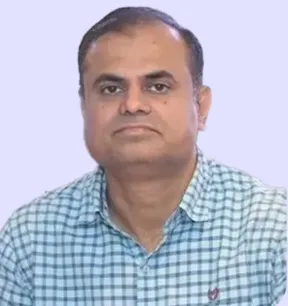
Dr. Harpreet Singh Bedi
Assistant Professor,
Department of Mechanical Engineering