

Centre for Robotics and Intelligent Systems
Shaping the Future of Intelligent Automation
At the Centre for Robotics & Intelligent Systems (CRIS), we develop prototypes of robots that provide greater intelligence and higher versatility for robotic tasks under ever-changing environmental constraints. We have acquired in-depth technical skills in the design and fabrication of robot manipulators and AGVs and devised intelligent control strategies for both manipulators and navigation, as well as their real-time implementations. Our long-term objective is to make the Indian industry competitive in this field by developing indigenous technical skills, manpower and innovative spirit.
Overview
The Centre for Robotics & Intelligent Systems (CRIS) came into existence in the year 1992. Earlier, it was known as the Centre for Robotics (CFR). Before that, an informal research group was working in this then-emerging area. This research group at CRIS has acquired in-depth technical skills in the design and fabrication of robot manipulators, AGVs and devised intelligent control strategies for both manipulators and navigation, as well as their real-time implementations.
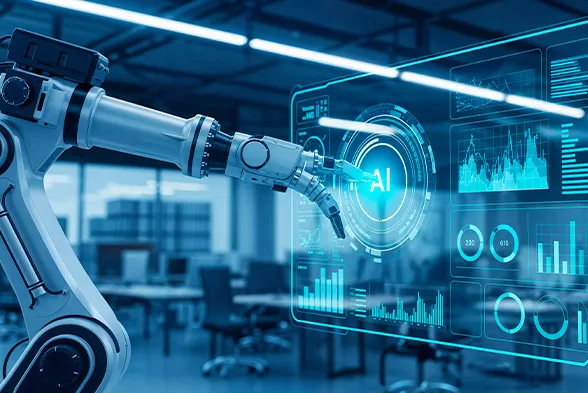
Research & Innovation
The Department of Robotics and Intelligent Systems at BITS Pilani has been at the forefront of innovation, producing award-winning research and developing advanced robotic systems that blend intelligence, precision, and adaptability. From humanoids to autonomous guided vehicles and mechatronic systems, the Centre has continually pushed the boundaries of intelligent automation.
Ongoing Projects
- Acyut-4 – A fully vision-based humanoid capable of advanced perception and motion control.
- Shaurya – A vision-based AGV designed to operate on uneven terrain and navigate dynamic, unstructured environments.
- Development of a Universal Foot System for humanoids.
- Quad-Rotor Development – Design and control of multi-rotor aerial robots.
- Mechatronic Ball – A spherical rolling robot with omnidirectional mobility.
- Acyut-I
- Acyut-II
- Acyut-III
- Shaurya-AGV
- Sketching Robot
Completed Theses
- Application of optimisation techniques to improve the performance of a robotic manipulator.
- Implementation of optimisation methods in manipulator design.
Ongoing Master’s Dissertation
- Investigation on the deterioration of mechanical properties and its influence on system reliability.
- Application of metamodeling techniques to reduce performance variation in a two-degree-of-freedom planar manipulator.
- Stochastic analysis of free particles in nano-sized regimes.
- Modelling and optimisation of a two-degree-of-freedom planar robot manipulator using artificial neural networks.
- Design of compliant mechanisms — life and reliability aspects.
A diverse range of master’s projects has explored areas such as intelligent control, vision systems, automation, sensor technology and robotic design. Notable projects include:
- Tape Tracking AGV using IR Sensors
- Servo Control with Feedback Card
- 2-DOF Close Kinematic Chain using Stepper Motor
- Simulation of Manipulator Motion using Pro-E
- Control Strategy Simulations using Fuzzy Logic and Neural Networks
- Step-Climbing Robot: Hydra
- Obstacle Avoidance by AGV using Ultrasonic Sensors
- Temperature-Sensing Gripper
- Alphabet Recognition Control using Neuro-Fuzzy Scheme
- Neural Network-based Robotic Control
- Path Planning of AGV using Vision Sensors
- Design and Analysis of Fuzzy-Controlled AGVs
- Design and Simulation of Biomimetic Hexapods
- Control and Simulation of SCARA Robots
- Fabrication of Lightweight Direct Drive Robotic Arms
- Design and Fabrication of Five-Fingered End-Effectors
- Vision-Based Pick and Place Robots (Arm & Gantry Types)
- Rope-Climbing Robot
- Design of Spray-Painting Robot
- Grass-Cutter Robot
- Floor-Wiping Robot
- Seed-Sowing Machine
- Automatic Blackboard Eraser Apparatus
- Step-Climbing AGV
- Ball and Socket RCC Device
- Humanoid Research Review
- Synchronisation of Rotating Table with Stamping Mechanism
- Vision-Based Object Detection on Conveyor with Optical Interface
- Mechatronic Systems – Locks, Doors, and Smart Lighting
- Automatic Drip Irrigation and Pumping Systems
- Tire Pressure Monitoring System
- Rotary Positioning Table Control via USB Port
- Simulation and Analysis of Multi-DOF Robotic Arms in MATLAB and Pro/E
- Development of Stepper & DC Motor Setups, Sensor Modules (IR, US, LDR, Strain Gauge, OpAmp, etc.)
Courses
The Department of Robotics and Intelligent Systems at BITS Pilani integrates advanced research directly into its academic framework, enabling students to learn from real-world innovations. The department’s award-winning research initiatives, including projects like Acyut-4, a fully vision-based humanoid and Shaurya, a vision-based AGV designed to navigate uneven terrain and dynamic environments, enrich the curriculum with hands-on learning and cutting-edge applications.
| Computer Code | Course Number | Course Name |
|---|---|---|
| 530 | BITS F415 | INTRODUCTION TO MEMS |
| 456 | BITS F441 | ROBOTICS |
| 741 | ME G511 | MECHANISMS & ROBOTICS |
| 369 | MSE G512 | MECHATRONICS |
| 369 | MF F319 | MECHATRONICS & AUTOMATION |
| 907 | BITS F313 | LAB ORIENTED PROJECT |
| 550 | BITS F314 | LAB ORIENTED PROJECT |
| 908 | BITS F323 | STUDY ORIENTED PROJECT |
| 911 | BITS F324 | STUDY ORIENTED PROJECT |
| 763 | BITS F421T | THESIS |
| 638 | BITS F422T | THESIS |
| 756 | BITS G629T | DISSERTATION |
| 553 | BITS G799T | PHD THESIS |
CRIS
Overview
The Centre for Robotics & Intelligent Systems is well-equipped with state-of-the-art facilities, both indigenously designed and constructed, as well as those purchased from various robot manufacturers.
Team
Our faculty members have extensive experience in industry, research and teaching. Our strength is a reflection of their skills, innovation and drive.
List of Faculty Members
| Faculty Name | Designation | Phone (+91-1596-51-) |
Email Address | Personal Website |
|---|---|---|---|---|
| Prof. B. K. Rout | Coordinator | 5430 | rout@pilani.bits-pilani.ac.in | Website |
| Prof. Sudeep Mohan | Nucleus Member | 5321 | sudeeptm@pilani.bits-pilani.ac.in | Website |
| Dr. Arshad Javed | Nucleus Member | — | arshad@hyderabad.bits-pilani.ac.in | Website |
| Mr. Tulsi Ram Sharma | Demonstrator | — | tulsi@pilani.bits-pilani.ac.in | — |
Thrust Areas of Research
At CEWRM, we address some of the most pressing challenges in water sustainability through focused research:

Impacts of climate change
on water resources

Systems approach to hydrologic
problems and modelling
Flood and Drought Studies
Soft Computing in Water Resources
How to Apply
Browse current openings, review eligibility criteria and
submit your application through our online portal.
For any technical issue during application submission, please reach out to HR at hr@dubai.bits-pilani.ac.in